

When Loving Others Leaves Your Heart Feeling Empty
It is 11:30 PM on a humid Tuesday night in Fort Lauderdale. You are sitting at your kitchen table, staring down at your phone, feeling a heavy weight in your chest. A text message notification lights up the screen—another late-night crisis from a well-meaning family member, another urgent demand from work, or another passive-aggressive comment from a spouse that leaves you walking on eggshells. Every bone in your body aches to type back a quiet “I can’t do this tonight,” but a deep, familiar surge of Christian guilt immediately stops your thumbs.
You ask yourself: Is it unchristian to say no? Am I failing to show God’s love if I protect my own sanity? Doesn’t Jesus call us to lay down our lives for others?
Across our South Florida community—from tight-knit multi-generational Hispanic and Latino homes in Broward County to fast-paced professional households in downtown Fort Lauderdale and vibrant Caribbean families in Miramar—thousands of believers wrestle with this exact silent torment. We confuse self-sacrifice with self-destruction. We mistake people-pleasing for holy peacemaking. In our earnest desire to honor God, we burn out our emotional, physical, and spiritual resources until we have nothing left to give to our families, our callings, or our Creator.
If you are feeling drained, resentful, or trapped in cycle after cycle of emotional exhaustion, take a deep breath. Setting biblical boundaries in relationships is not a selfish betrayal of your faith—it is God’s divine, life-giving design for long-term health, peace, and true spiritual intimacy.
The Path to Relational Rest: A Faith-Based Counseling Framework
1. Empathetic Validation: Meeting You in the Exhaustion of People-Pleasing
It is vital to name what you are experiencing without shame. Feeling resentful does not mean you are a bad Christian; it means your personal God-given emotional reserves have been depleted past their safety margin. When you live without personal boundaries, your days become a continuous exercise in triage. You say “yes” to keep the peace at home, “yes” to avoid conflict at church, and “yes” to satisfy overbearing relational demands—yet the quiet peace you long for never arrives. Instead, resentment quietly takes root.
In clinical practice, we often see that chronic self-neglect leads to nervous system overload. Your body stays locked in a heightened fight-or-flight state, resulting in persistent anxiety, tension headaches, panic symptoms, or relational burnout. God did not construct your mind and nervous system to carry the emotional burdens of every person around you. Validating your limits is the first essential step toward emotional and spiritual healing.
2. Unpacking the Root: Biblical & Psychological Insights into Boundary Weakness
Why is setting biblical boundaries in relationships so difficult for sincere believers? To find lasting freedom, we must look beneath the surface symptoms and examine the deep roots formed in our hearts, past experiences, and cultural upbringing.
- The Fear of Man vs. The Fear of God: Many believers operate under what Scripture calls “the fear of man” (Proverbs 29:25). We sub-consciously prioritize the approval, comfort, and validation of parents, partners, or peers above the quiet peace God offers. When human approval becomes our functional savior, a simple “no” feels like a catastrophic threat to our security.
- Cultural and Family Enmeshment: In many South Florida multi-generational households, family loyalty is deeply cherished—yet it can sometimes cross into enmeshment, where personal identity, decision-making, and emotional states are entirely fused. Disentangling your personal identity to establish healthy independence can trigger intense guilt or accusations of disrespect.
- Misinterpreting Biblical Self-Sacrifice: We often twist Jesus’s command to “love your neighbor as yourself” (Mark 12:31) into “love your neighbor instead of caring for yourself.” Biblical love requires a whole, surrendered heart—not an eroded, resentful soul operating on empty.
As Christian counseling pioneer Dr. Ed Welch highlights in his foundational work When People Are Big and God Is Small, our desperate need for human approval often eclipses our reverence for God’s design. Welch points out that when we elevate the expectations of others above God’s clear boundaries, we trade divine peace for human control. Recognizing this dynamic frees us to stop managing everyone else’s emotions and begin honoring God’s design for our lives.
3. The Healing Pathway: 7 Practical Keys to Setting Biblical Boundaries in Relationships
Establishing healthy boundaries is both a spiritual discipline and a learned therapeutic skill. Here are 7 actionable, Christ-centered keys to guide your journey toward restored freedom and healthier ties.
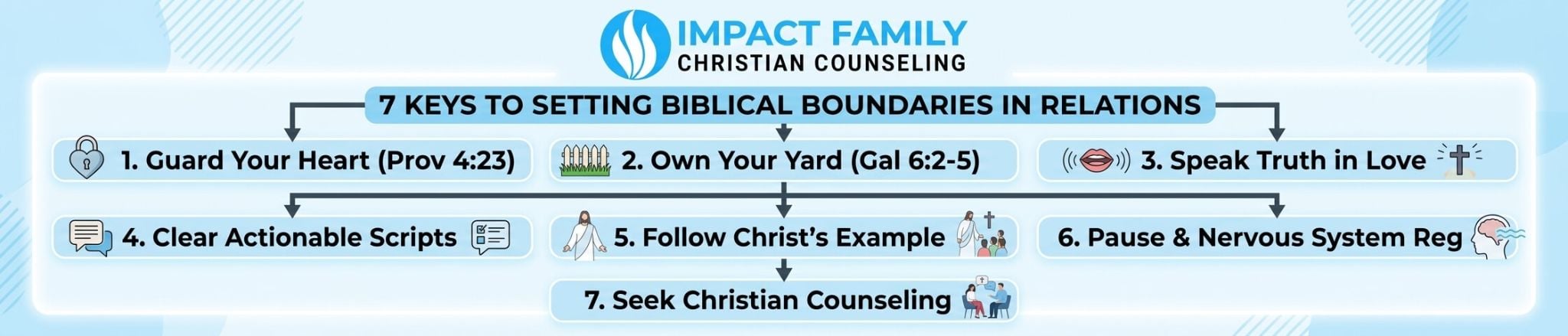
Key 1: Recognize That Boundaries Are God’s Original Design
Boundaries are not a modern secular invention; they originate in the very heart of God. In Genesis, God created order by setting clear boundaries between light and darkness, sea and dry land. In Proverbs 4:23, Holy Scripture commands us: “Above all else, guard your heart, for everything you do flows from it.” A boundary is simply a spiritual and emotional fence around the garden of your heart. It defines where your responsibilities end and another person’s responsibilities begin.
Key 2: Understand the Difference Between “Burdens” and “Loads”
Galatians 6 provides a masterclass in relational balance. Galatians 6:2 instructs us to “Carry each other’s burdens,” referring to overwhelming crises, grief, or sudden life catastrophes that require community support. Yet just three verses later, Galatians 6:5 states, “for each one should carry their own load.” The Greek word for load (phortion) refers to everyday personal responsibility—our own choices, attitudes, and emotional reactions. Setting biblical boundaries in relationships means refusing to carry someone else’s daily load while remaining available to help carry true catastrophic burdens.
Key 3: Practice Speaking Truth in Love Without Over-Explaining
Ephesians 4:15 calls believers to “speak the truth in love.” When setting a boundary, avoid falling into long justifications, defense mechanisms, or apologetic explanations. Over-explaining invites negotiation. State your boundary clearly, calmly, and kindly.
- Unhealthy: “I’m so sorry, I wish I could help, but I’m just so stressed and my week has been crazy, so maybe next time if things calm down…”
- Biblical & Clear: “I love you and value our relationship, but I am unable to commit to that request right now.”
Key 4: Implement Actionable Boundary Scripts for Daily Life
Having clear, prepared language helps steady your voice when emotions run high. Here are practical boundary scripts tailored for family, marriage, and work:
- For Family/Parents: “I appreciate your input and love for our family. However, my spouse and I have prayed and decided on this direction together.”
- For Marriage: “I want to hear what you are feeling, but I cannot continue this discussion while voices are raised. Let’s take 20 minutes to cool down and reconnect.”
- For Overdemanding Friendships: “I am stepping away from my phone after 8 PM to focus on family time, so I will get back to you tomorrow morning.”
Key 5: Follow Jesus’s Example of Holy Solitude and Limit-Setting
Jesus Christ modeled perfect, sinless boundary setting. Despite overwhelming human need, Jesus frequently withdrew from demanding crowds to pray and rest (Luke 5:16). When Peter urged Him to stay in Capernaum because “everyone is looking for you,” Jesus firmly said no, prioritizing God’s specific mission over human expectations (Mark 1:37–38). Following Christ means honoring your human limits as He honored His earthly rhythms.
Key 6: Practice Nervous System Regulation Anchored in Scripture
When you enforce a boundary, your body may register immediate discomfort, guilt, or fear of rejection. Instead of giving in to panic, practice somatic grounding rooted in Scripture. Sit quietly, plant your feet on the floor, take deep breaths, and meditate on Psalm 46:10: “Be still, and know that I am God.” Remind your body that peace comes from God’s approval, not human compliance.
Key 7: Seek Professional Faith-Based Counseling
Unpacking deeply ingrained patterns of people-pleasing, codependency, or generational trauma often requires experienced guidance. Working alongside a Christian counselor allows you to safely process past hurts, practice healthy communication skills, and rebuild your relationships on solid biblical footing.
4. Vision for Restoration: Hope, Peace, and Resilient Connection
Imagine what your life and home will look like when healthy, Christ-centered boundaries are established.
Picture waking up in your South Florida home without that lingering knot of anxiety in your stomach. Imagine having open, honest conversations with your spouse where both of you feel heard, respected, and cherished—free from silent resentment. Picture gathering with extended family for holiday meals in Fort Lauderdale or Miami with genuine joy, knowing your personal limits are established and your heart is protected.
When you practice setting biblical boundaries in relationships, you do not push people away; you create a safe, stable environment where authentic love, mutual respect, and deep spiritual connection can truly flourish.
Transform Your Relationships: Reach Out to Impact Family Today
Are you ready to break free from the exhausting cycle of people-pleasing, relational anxiety, and emotional burnout? You do not have to navigate this journey alone.
At Impact Family Christian Counseling, located in the heart of Fort Lauderdale, Florida, our compassionate team of licensed and faith-integrated counselors is dedicated to helping individuals, couples, and multi-generational families across South Florida experience lasting healing. Whether you need specialized Christian marriage counseling in Fort Lauderdale, individual anxiety support, or guidance on establishing healthy family dynamics, we provide a warm, confidential, and biblically grounded space for your recovery.
We believe that professional counseling should be accessible to everyone in our community, which is why we offer both in-person sessions at our Fort Lauderdale office and convenient virtual therapy, alongside flexible sliding-scale fee options.
Take your first brave step toward lasting peace and healthy ties today.
- Schedule Your Session: Visit our Impact Family Session Page to book your appointment online.
- Learn More About Our Approach: Discover how we combine evidence-based therapeutic tools with eternal biblical truth at Impact Family Counseling Approach.
- Find Our Office: Explore our central location details and virtual options at Impact Family Locations.
Call us today or visit https://impact.vision/ to begin your journey toward emotional freedom, restored relationships, and divine peace.